Managing 2,000-Word Academic Essays: A Comprehensive Student Strategy for 2026
Stepping into a 2,000-word essay assignment can feel like standing at the base of a mountain. For many undergraduate students, this is the “sweet spot” of academic writing—it’s long enough to require deep research, yet short enough that every single sentence must provide value. In the 2026 academic landscape, where digital literacy and critical thinking are more important than ever, mastering this length is a vital skill for your GPA and your future career.
When you first see that word count on your syllabus, your mind likely jumps to the logistics of formatting. One of the most common questions students ask is how much physical space that text will actually occupy on a document. Understanding how many pages is 2000 words is the first step in visualizing your workload; typically, this translates to about 4 pages if you are single-spacing or 8 pages if you are double-spacing with standard margins. Once you have that visual goal in mind, the daunting “2,000” becomes a manageable set of pages to fill with your unique insights.
The Psychology of the 2,000-Word Milestone
Why do professors love this specific length? It’s designed to test your ability to move beyond surface-level observations. A 500-word essay is a snapshot; a 1,000-word essay is a summary; but a 2,000-word essay is an argument. It requires you to balance a broad overview of a topic with specific, “surgical” analysis of evidence. To succeed, you must shift your mindset from “filling space” to “building a case.”
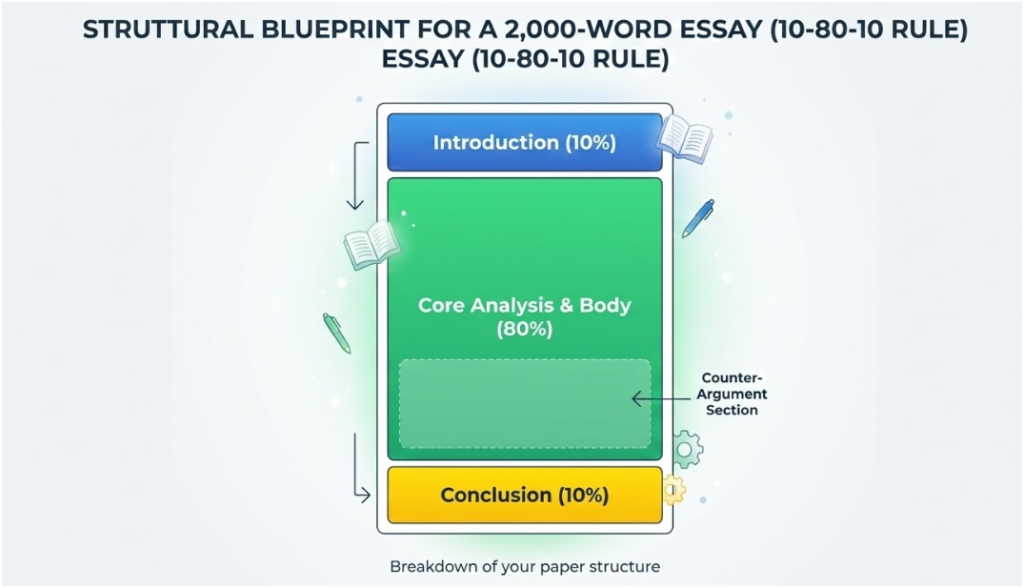
Phase 1: The Strategic Breakdown (The 10-80-10 Rule)
A successful essay is built on a solid skeleton. Without a structure, 2,000 words will quickly turn into a rambling mess that loses the reader. Most high-scoring papers follow a proportional distribution of content.
| Essay Section | Word Count Allocation | Purpose |
| Introduction | 200 – 250 Words | Hook the reader, provide context, and state the thesis. |
| Literature Review | 300 – 400 Words | Show what other experts have said about the topic. |
| Core Analysis (Body) | 1,100 – 1,200 Words | The “meat” of the essay where you present your evidence. |
| Counter-Arguments | 200 – 300 Words | Addressing the other side to show balanced thinking. |
| Conclusion | 200 – 250 Words | Summarizing findings and looking at future implications. |
Phase 2: Deep Research in the Age of Information Overload
In 2026, the challenge isn’t finding information—it’s filtering it. With the rise of AI-generated content and endless digital archives, your job is to find the “gold” among the “gravel.” Start by identifying five to seven core academic sources. These should be peer-reviewed journals, books, or reputable news outlets.
As you research, keep a “Quote Bank.” Every time you find a powerful statistic or a profound thought, copy it into a separate document with the full citation. This prevents the “citation panic” that usually happens two hours before the deadline when you can’t remember where that perfect fact came from.
Phase 3: Drafting and Seeking Support
Writing the first draft is often the hardest part. The “blank page syndrome” can paralyze even the best students. The trick is to write the body paragraphs first. If you know what your evidence says, writing the introduction becomes much easier because you know exactly what you are introducing.
However, sometimes the pressure of multiple deadlines or a particularly complex topic can lead to a block. In these moments, many students find that professional essay writing help from MyAssignmentHelp can provide the necessary clarity. Whether it’s seeing how a professional structures a thesis or getting a second pair of eyes on your bibliography, using external resources ethically can be a great way to learn the nuances of academic tone and formatting that are often skipped in large lecture halls.
Phase 4: Navigating the 2026 “Originality” Standards
Academic integrity has evolved. Today, universities use highly sophisticated tools to check for not just “copy-pasting,” but also “stylistic consistency.” This means your essay needs to sound like you.
To maintain a human, authentic voice, try the “Read Aloud” method. If you read a paragraph out loud and you find yourself running out of breath or getting confused by your own sentence, it’s too complex. Break long sentences into two. Use transition words like “Furthermore,” “Conversely,” and “In light of this” to guide your professor through your logic.
Phase 5: The Final 10% – Editing for Impact
Most students stop writing the moment they hit word 2,000. This is a mistake. The difference between a B and an A often lies in the final polish.
- Check the “Flow”: Does paragraph three naturally lead into paragraph four?
- Verify Citations: Ensure every “In-text” citation has a matching entry in your Reference List.
- The “So What?” Test: Read your conclusion. Does it answer the question, “Why does this topic matter in the real world?” If not, add a sentence about the broader impact of your findings.
Conclusion: Turning Words into Wisdom
Writing 2,000 words is more than just an academic hurdle; it is an exercise in discipline and communication. By breaking the task into smaller chunks, visualizing the physical layout of your pages, and knowing when to seek expert guidance to refine your skills, you transform a stressful assignment into a showcase of your expertise. Remember, the goal isn’t just to finish the essay—it’s to master the topic.
Frequently Asked Questions (FAQ)
Q1: Is 2,000 words too long for an undergraduate essay?
Not at all. It is the standard length for mid-to-upper-level university modules. It allows enough room to explore a topic deeply without becoming as exhausting as a 10,000-word dissertation.
Q2: How many references should I include for a 2,000-word paper?
A good rule of thumb is 1 to 2 high-quality references for every 250-300 words. For a 2,000-word essay, aiming for 8 to 12 solid sources is generally expected by most professors.
Q3: Can I use “I” in a 2,000-word academic essay?
This depends on your field of study. In reflective journals or nursing papers, “I” is often encouraged. However, in sciences, law, or business, it is usually better to use third-person (e.g., “The evidence suggests…” rather than “I think…”). Always check your specific department’s style guide.
Q4: What happens if I am slightly under or over the word count?
Most universities allow a 10% margin. For a 2,000-word assignment, this usually means you are safe between 1,800 and 2,200 words. However, check your rubric, as some strict instructors may penalize you for being even one word over.
Q5: How can I increase my word count if I’m stuck at 1,500?
Don’t add “fluff.” Instead, look for a point in your body paragraphs that needs more evidence. Adding a case study or a more detailed analysis of an existing quote is the best way to reach your goal while actually improving the quality of the paper.
About The Author
I am Mark, a dedicated academic consultant with over a decade of experience in helping undergraduate students navigate the complexities of higher education. Associated with MyAssignmentHelp, I focus on bridging the gap between raw research and high-impact academic writing. My mission is to provide students with actionable strategies that improve their research methodologies and workload management in an ever-evolving digital landscape.
Stay in touch to get more updates & news on The Knowledge Arrow!