Brand Awareness Marketing Strategy: A Complete Guide for Growing Businesses
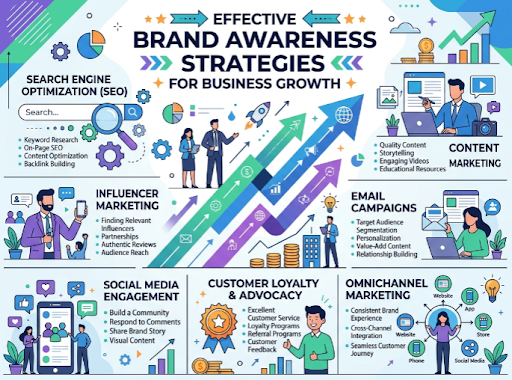
Most companies don’t lose customers because their product is weak. They lose them because nobody knew the product existed in the first place. That’s the gap a solid brand awareness marketing strategy is built to close making sure the right people recognize your name, remember what you stand for, and think of you first when they’re ready to buy.
This guide breaks down what brand awareness really means, how to build it across digital and local channels, and how to turn that visibility into long-term customer loyalty without resorting to vague theory or recycled checklists.
What a Brand Awareness Marketing Strategy Actually Involves
A brand awareness marketing strategy and character animation services is the structured plan a business uses to increase how often, and how positively, its target audience encounters its name, voice, and visual identity. It sits above individual campaigns it’s the umbrella that decides which channels, messages, and touchpoints will consistently reinforce who you are.
A strong strategy answers three questions before a single ad is created or a single post is published:
- Who exactly needs to recognize us, and where do they already spend their attention?
- What single impression do we want to leave behind every time someone interacts with us?
- How will we know the strategy is working beyond likes and impressions?
Skipping these questions is why so many awareness campaigns produce noise instead of recall. A name people saw once and forgot isn’t awareness; it’s wasted ad spend.
How to Increase Brand Awareness Without Wasting Budget
If you’re wondering how to increase brand awareness in a way that actually compounds over time, start with consistency rather than volume. Posting everywhere, all at once, rarely beats showing up reliably in two or three places your audience already trusts.
A few approaches that reliably move the needle:
- Own a narrow niche first. Businesses that try to be visible to everyone usually end up memorable to no one. Pick the specific problem you solve better than anyone else and repeat that message until it sticks.
- Use repetition with variation. The same core message, told through different formats — a video, a case study, a quick tip reinforces recall without feeling repetitive to the audience.
- Borrow audiences you haven’t earned yet. Podcast guesting, co-marketing with adjacent (non-competing) brands, and influencer partnerships put you in front of people who already trust the host, which transfers some of that trust to you.
- Make your visuals do the recognizing. Consistent colors, typography, and tone across every channel mean people can identify your brand before they even read your name.
None of these require a massive budget. They require discipline and a clear point of view.
Digital Marketing for Brand Awareness: Where to Focus First
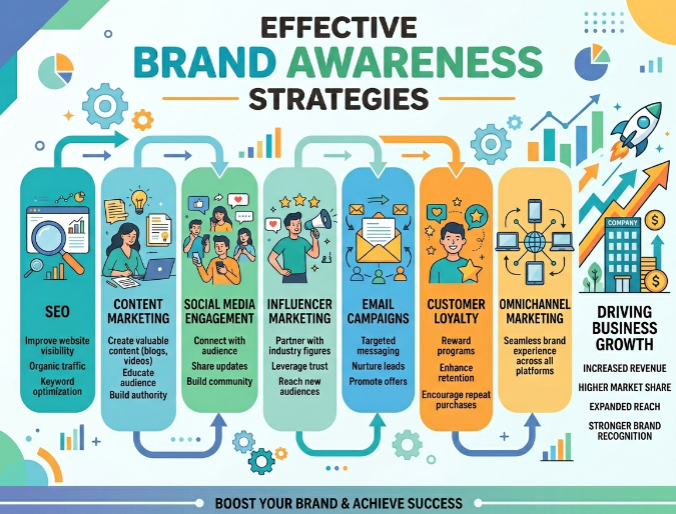
Digital marketing for brand awareness works because it lets a business show up repeatedly, in context, at a fraction of the cost of traditional advertising. The channels that matter most depend on where your audience actually spends time, but a few tend to deliver outsized returns:
Search and SEO content puts your brand in front of people while they’re actively researching a problem you solve arguably the most receptive moment for first impressions. Social media, used for storytelling rather than constant selling, builds familiarity through small, frequent touchpoints. Email newsletters keep your name in front of people who’ve already shown interest, reinforcing recall between purchases. Video, especially short-form, tends to outperform static content for memorability because it engages more senses at once.
The mistake many businesses make is treating these channels as separate experiments instead of one connected system. A blog post should feed social content, which should drive email signups, which should nurture people back toward the brand’s core message. When channels reinforce each other, awareness builds faster than any single channel could produce alone.
Effective Brand Awareness Strategies That Hold Up Over Time
Not every tactic ages well. Many effective brand awareness strategies share a common trait: they create something people want to share or return to, rather than something they merely tolerate.
Educational content tends to outperform purely promotional content because it gives people a reason to engage even when they’re not ready to buy. Original research or data even something as simple as a small survey of your own customers earns coverage and backlinks that a generic blog post never will. Community building, whether through a private group, a recurring event, or an engaged comment section, turns passive followers into active advocates who mention your brand without being asked.
The strategies that hold up share another quality: they reflect something true about the brand, rather than chasing whatever tactic is trending that month.
Building a Brand Awareness Marketing Plan Step by Step
A brand awareness marketing plan turns strategy into action with specific timelines, owners, and metrics. A workable structure looks like this:
- Define the audience precisely. Not small business owners, but the specific role, industry, and pain point you’re targeting.
- Set a measurable goal. Branded search volume, direct traffic, or share of voice are better indicators of awareness than vanity metrics like follower counts.
- Choose two or three core channels based on where that audience already spends time, not where competitors happen to be active.
- Create a content calendar that repeats key messages across formats over weeks, not days awareness is built through frequency, not a single viral moment.
- Track and adjust quarterly, since awareness metrics move slower than conversion metrics and need a longer measurement window to read accurately.
The plan doesn’t need to be elaborate. It needs to be specific enough that someone could execute it without further clarification.
Local Brand Awareness Marketing: Winning Attention Close to Home
For businesses serving a defined geographic area, local brand awareness marketing works differently than national campaigns. Proximity and trust matter more than reach.
Claiming and actively updating a Google Business Profile remains one of the highest-impact, lowest-cost moves available, since it directly affects whether your business appears when nearby customers search. Sponsoring local events, partnering with neighboring businesses for cross-promotion, and encouraging satisfied customers to leave detailed reviews all build the kind of community-level recognition that national ad budgets can’t easily replicate. Local press and community newsletters, often overlooked, still carry significant weight with audiences who trust hyper-local sources more than broad digital ads.
The throughline for local awareness is visibility paired with reputation being seen, and being spoken well of, within the same community repeatedly.
B2B Brand Awareness Strategy vs. B2C Brand Awareness Strategy
A B2B brand awareness strategy and a B2C brand awareness strategy share the same goal but rarely the same playbook.
In B2B contexts, awareness is built through credibility signals case studies, industry speaking engagements, LinkedIn thought leadership, and peer recommendations carry more weight than broad reach, because purchase decisions involve multiple stakeholders who research carefully before engaging. The sales cycle is longer, so awareness needs to be sustained over months, not days.
In B2C contexts, emotional resonance and frequency tend to matter more than credibility alone. Visual platforms, influencer partnerships, and timely cultural relevance drive faster recognition, since consumer purchase decisions are often made quickly and influenced by social proof from peers rather than industry experts.
Businesses that try to run identical playbooks across both contexts usually underperform in one direction or the other either too dry for consumer audiences or too informal for enterprise buyers.
Customer Awareness Marketing: Turning Recognition into Loyalty
Awareness alone doesn’t keep a business running what happens after someone recognizes your brand matters just as much. Customer awareness marketing focuses on educating existing and prospective customers about how to get the most value from a product, which deepens the relationship beyond a single transaction.
This includes onboarding content that helps new customers succeed quickly, transparent communication about pricing and product changes, and proactive education about features customers might not be using yet. Done well, this turns customers into the most credible source of future awareness, since word-of-mouth from a genuinely satisfied customer outperforms almost any paid channel.
Frequently Asked Questions
How long does it take to build brand awareness? Most businesses start seeing measurable shifts in recognition after three to six months of consistent activity, though meaningful market-level awareness often takes a year or more, depending on competition and budget.
What’s the difference between brand awareness and brand recognition? Brand awareness refers to whether people know your business exists; brand recognition refers to whether they can identify your brand from visual or verbal cues alone, such as a logo or tagline, even without seeing the name.
Do small businesses need a different approach than large companies? Yes. Small businesses typically get better returns from focused, local, and community-based tactics, while larger companies can sustain broader, multi-channel campaigns due to bigger budgets and existing market presence.
Which metrics actually prove a brand awareness strategy is working? Branded search volume, direct website traffic, social mentions, and share of voice against competitors are more reliable indicators than impressions or follower growth alone.
Can paid advertising alone build lasting brand awareness? Paid ads can accelerate visibility, but lasting awareness usually requires organic reinforcement content, community, and word-of-mouth since recognition built solely through paid reach tends to fade once spending stops.
Awareness Thoughts
Brand awareness isn’t a single campaign or a one-time push it’s the cumulative result of consistent, recognizable, and genuinely useful interactions over time. Whether the goal is local recognition, B2B credibility, or consumer-level recall, the businesses that win are the ones that treat awareness as an ongoing discipline rather than a short-term tactic. Start with a clear plan, pick the channels your audience already trusts, and let consistency do the heavy lifting.